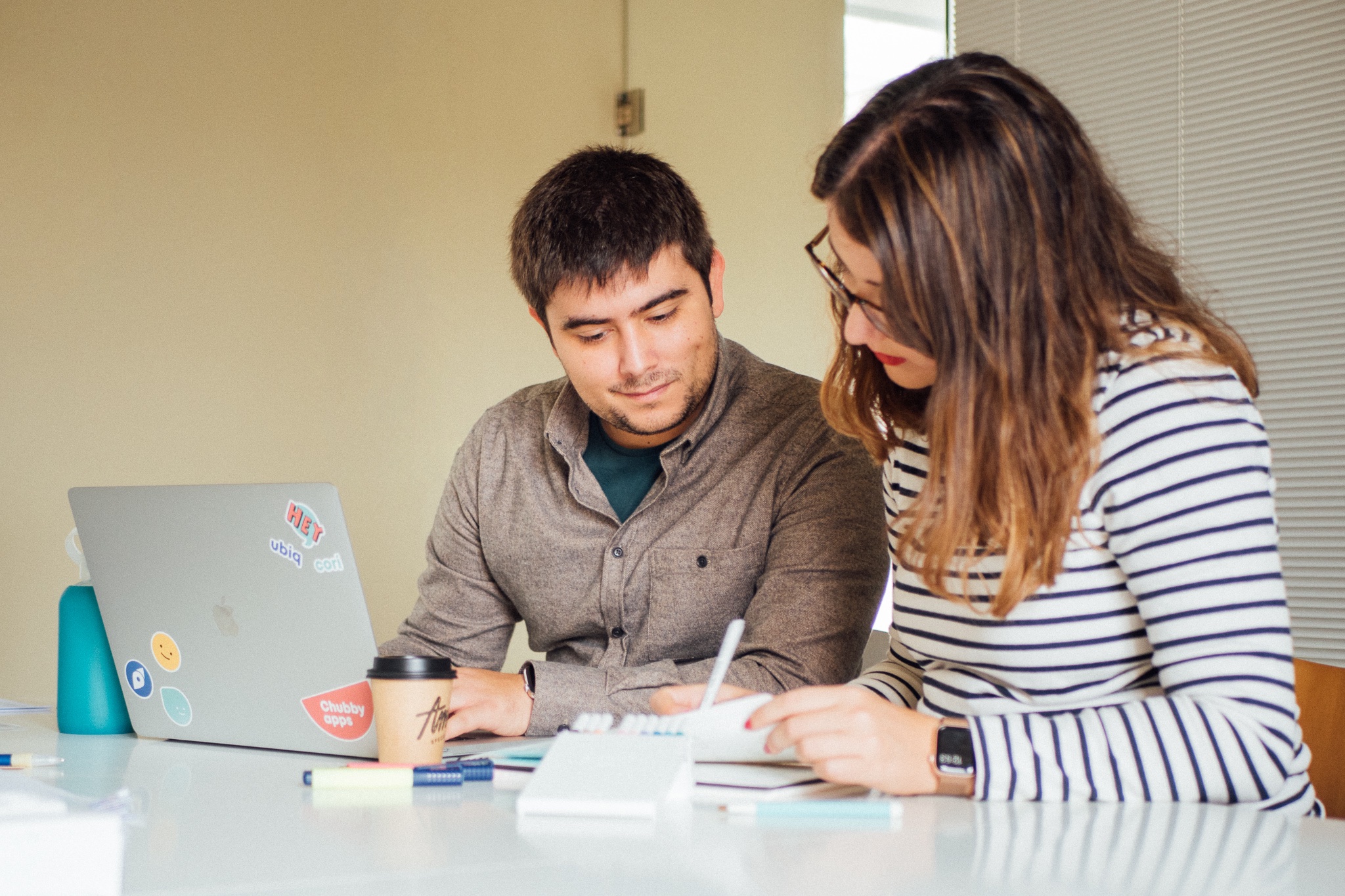
Interview with Patricia Bedoya and Asier García-Morato, Chubby Apps founders
How was Chubby Apps born and what was the spark that led you to start in the world of app development?
Chubby Apps was born in 2020, right in the middle of the pandemic, a moment as complex as it was full of lessons. A year earlier, we had launched our first entrepreneurial idea, BEGia, a software designed to guide people with low vision in commercial spaces. The pandemic cut that project short, but it also gave us a certainty: our way of understanding technology was different. For us, people always had to be at the center of any technological development. From that conviction, Chubby Apps was born, and since then we have been working on creating apps that make life a little easier and more meaningful.
You’re going all in with FitWoody V2. How have you pivoted from the beginning of FitWoody to today?
FitWoody was born in 2023 as an MVP, built from the core of Cori, a previous app we developed for diabetes management. We’ve always been passionate about health and prevention, and soon we realized that from that perspective we could generate a much greater impact. In barely two months, we launched the first version of FitWoody on the App Store, which we then refined with several updates.
The product fit the market very well: in two years, we’ve reached more than 50,000 users worldwide, translated the app into 36 languages, and received recognition as one of the best apps for watchOS 11 and iOS 18. That validation showed us it was the right time to take a leap in quality.
We’ve been working for a year on FitWoody V2, a completely redesigned version supported by on-device AI. Its goal is to help you achieve your goals by adapting your training plan to your real physical condition and, above all, to achieve the hardest thing: that you don’t give up at the first setback.
This new stage launches on October 23, after having tested it with more than 5,000 users who gave us very positive feedback. We’re eager to see how it grows and, above all, how it transforms the lives of more people. Receiving messages from parents telling us that, thanks to FitWoody, they once again have the energy to play with their kids is the best reward we could imagine.
What other projects have you been involved in? Any news you can share with us?
We love working on projects where we feel we can really move the needle for people and organizations. It’s not always about creating an app from scratch, but about thinking how technology and design can become levers to achieve business or social goals.
We’ve collaborated with SPC, the only Spanish smartphone manufacturer, based in Vitoria, on several very special projects. One of them was SPC Care, a system that allows family members to monitor and support older people from their phones, with practical functions such as blocking spam calls, raising the phone’s volume remotely, or locating the person on a map. We also participated in the redesign of their new smartphone for seniors, aiming to make it more accessible and user-friendly.
Another case that excites us is the Araba Basketball Club, a women’s training team with an outstanding level. They asked us for help improving their internal and external perception, and after months of work we’re building together a digital and brand identity that reflects the enormous talent they have.
We’ve also worked on international projects such as Val-Dieu, a Belgian brewery with tradition dating back to the 13th century. We helped them enter Spain with a digital and design strategy that respects their history while connecting them to a new market.
And we don’t forget the Alava ecosystem: we love supporting entrepreneurs in the early stages, helping them shape their ideas and create impactful products that truly succeed.
As for news… we can share that we continue exploring new paths in health and sports, as well as digital transformation projects with companies that want to approach technology from a more human perspective.
How does it feel to have companies like Apple or Pfizer trust your work?
Honestly, it was incredible to receive recognition from companies like Apple or Pfizer, and to see that they continue to count on us. Having two of the biggest companies in the world bet on your work in fields as demanding as health and technology is an enormous boost and, above all, a very clear validation that what we were building was heading in the right direction.
For us, they are not only global benchmarks, but also travel companions who have supported us from the beginning and motivate us to keep raising the bar in everything we do.
Which companies, projects, or people inspire you in your work?
We have very diverse role models, both personal and professional. First of all, we are inspired by the tenacity and effort of our parents, who were also entrepreneurs and passed on to us the ability to fight for what we believe in. And, of course, we are inspired by many of the entrepreneurs we work with every day, who arrive with contagious energy and a huge drive to conquer the world.
We also have more public references. We greatly admire the work of Instituto Tramontana, which combines training, experience, and community around design and technology. We’ve both trained with them in different areas and we believe they are still little known in Spain, despite the great value they bring. Being able to learn from professionals with such real-world experience in the sector, like Javier Cañada, Iñigo Medina, or Isabella Cuppis, is a privilege.
On the international stage, we closely follow companies like Framer, Linear, and RevenueCat, because we love how they build product culture. They inspire us because they always put people at the center: behind every email, every reply, and every new feature, there’s a reflection on what their users really need. They don’t build technology just for the sake of it, but because they believe it’s worth it and they know who they’re building it for.
What has been the biggest challenge you’ve faced so far? And the biggest learning? And what advice would you give to those thinking of starting out in this sector?
Our biggest challenge has been believing in ourselves and understanding what our real value proposition was. We’re not just a company that designs screens or writes lines of code. What we do is accompany entrepreneurs and companies in transforming their vision of technology and their own business. Our value lies in empathy, in truly listening, and in putting good work first. It took us time to understand how different that was compared to just “coding away” or making “infinite figmas.”
The biggest learning has been that when you work from empathy and purpose, projects not only work better: they also generate a much more lasting impact.
And if we had to give one piece of advice to beginners, it would be this: don’t get dazzled by the trend of the moment, AI, a thousand features, or an endless roadmap. Build from the essentials, in public, with your community, without fear of receiving criticism. It’s the most honest way to learn, improve, and, above all, create a product that truly works and reaches people.
Any anecdote or unforgettable moment you’d like to share since you started with Chubby Apps?
One of the moments we remember most fondly was when we were working in Boston with Pfizer, while also participating in the Apple Entrepreneur Camp. It was a true American adventure, intense and exciting, where we learned a lot and that marked a before and after in our way of working.
And then there are those unexpected anecdotes that make us smile: like when we go to Barcelona or Madrid and someone comes up saying, “Hey, you’re the Chubbys, right?”. It’s both curious and very special to feel that spontaneous recognition from people who value what we do.
Quick-fire round
- Movies about entrepreneurship you’d recommend?
We couldn’t stick to just one, so we recommend two Apple TV+ series.
The first is WeCrashed, which tells the story of WeWork. We’re fascinated by that portrait of the “delulu” of fundraising rounds, where sometimes you don’t know if the money is being spent on t-shirts or champagne, and how everything can collapse overnight.
The second is Ted Lasso. At first, it doesn’t seem to have anything to do with entrepreneurship, but for us, it reflects it better than many startup stories: a leader who, despite having everything against him, manages to unite a team, create culture, and move a project forward. That is, after all, what entrepreneurship is.
-
Phrase that reflects your work philosophy
We think, design, and build technology without an instruction manual.
-
If you could have a meeting with any historical figure, who would it be?
We have different answers here. Asier would choose Jony Ive, for the way he managed to transform Apple through design, bringing simplicity and innovation to every product. I, on the other hand, would choose Dieter Rams, because I’ve always been fascinated by how a designer could influence and transform an entire corporation from the highest levels of leadership.
In the end, both represent the same thing: the power of design as a strategic engine capable of changing not only products, but also the way we understand technology.
-
If you could go back in time, would you start a business again?
SHARE