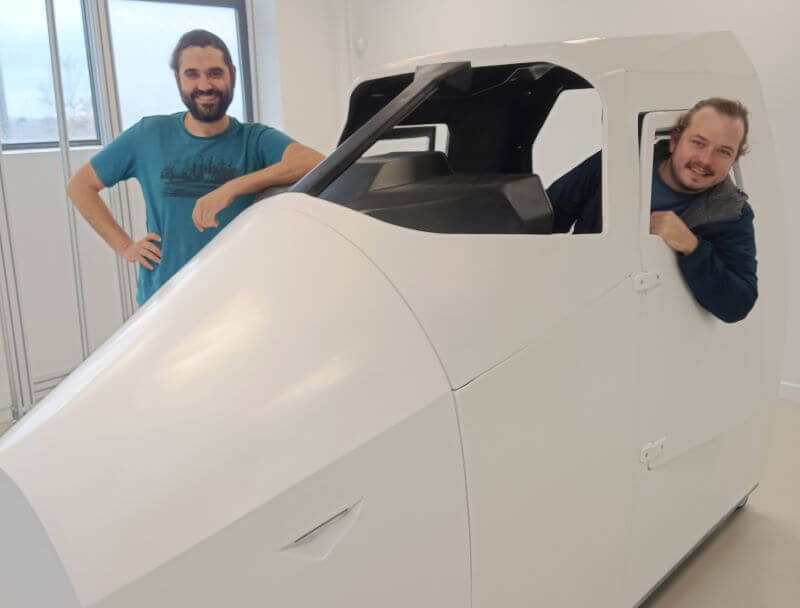
Interview with Jose Ramón Lasa, founder of Lasa Dynamics
How was Lasa Dynamics born? What was the starting point that led you to create the company?
Lasa Dynamics was born from an idea that had been on my mind for more than a decade, since my early days in the simulation industry. Over time, I accumulated experience and developed a very clear vision of what I would want as an end user. The current market, with its growing demand for training, was a decisive factor that led to the decision to start the project. The journey has been long, but without the desire to design and build these complex devices that we are passionate about, we would never have taken the step. In addition, my partner Ignacio Soriano brings strong experience in simulation software for demanding environments, and that combination allowed us to tackle a project of this scale with a solid foundation, both from a technical standpoint and in terms of regulatory compliance.
What is the main technology you work with and what sets you apart in its application?
Our technology is the full integration of a flight training system: hardware, software, control systems, and the cockpit experience, with a very clear focus—designing from the outset with certification, real operation, and maintenance in mind. What sets us apart is that we are not just “a supplier of a single component”: we work as an end-to-end partner, from initial design through to commissioning. We follow a product philosophy oriented toward clean, scalable architecture that does not lock the customer in. In fact, something very important to us is that the customer understands the aspects of our design and the benefits they bring to daily operations—ultimately, that they feel what they are buying truly belongs to them.
How is the current team structured and which profiles are key to your growth?
Today we are a small, highly technical, multidisciplinary team. In terms of numbers, we are around four people in day-to-day operations, supported by collaborators as specific needs arise. Key profiles for growth include systems engineering and integration, simulation software, electronics/mechatronics, and everything related to certification and regulated operations. In other words, it’s not enough for something to “work reliably”: it has to be auditable, maintainable, and certifiable. Of course, communication and marketing are also essential.
You’ve just certified your first flight simulator, integrating your own technology and third-party solutions—congratulations! How do you experience this milestone?
With great joy and a strong sense of responsibility. In this sector, certification is the final validation that you are not selling an expensive toy. It also means that a customer trusts you, integrates the system into their operation, and that an authority officially recognizes it. For a new player, that first certification is a huge validation of the product, the engineering process, and the ability to meet regulatory requirements. From here on, the milestone gives you credibility, but it also raises the bar: now we have to demonstrate that we have the flexibility to simulate any aircraft using our own technology, scale it, and make it sustainable.
What are the next steps or goals you’ve set for Lasa Dynamics in the coming months? And how do you envision Lasa Dynamics in five years?
In the short term, the focus is on completing the software/hardware integration and certification of our first simulator manufactured entirely with proprietary technology, and on continuing to consolidate agreements with training centers. In parallel, we’re pushing forward projects already underway, such as another Boeing 737 simulator that is in the final phase of certification. In five years, I imagine Lasa Dynamics as a recognized and trusted partner for training organizations, with multiple devices deployed for both fixed-wing aircraft and helicopters.
What has been the biggest challenge you’ve faced as founders?
The hardest part is that this is a project with very long, complex processes in a regulated market: it requires a lot of engineering, extensive documentation, and long cycles before seeing results. Maintaining focus, cash flow, and motivation while building something that has to pass very demanding technical and regulatory filters is a huge challenge. Then there’s the challenge of earning the trust of the first customer: in simulation, credibility is built on facts, and getting someone to trust you without certifications behind you is difficult.
In one sentence, how would you define the essence of Lasa Dynamics?
Certifiable, reliable flight simulation built with proprietary engineering that can be maintained in an agile way.
If you could give one piece of advice to those just starting out, what would it be?
Seek relationships with collaborators and suppliers that go beyond a purely commercial relationship. Complex projects need “friends” whose interest is not only financial compensation, but also contributing to success. People like to help, and knowing how to give and ask for help is important. In addition, for regulated projects, our advice is: design with compliance in mind from the very beginning, because reworking things later is extremely expensive.
Quick-fire questions
Entrepreneurship-related films you would recommend?
The Founder: it shows how a simple idea can grow thanks to clear processes and standardization. It highlights the importance of marketing, branding, and systems to scale a business.
A phrase that reflects your work philosophy
Quality with specifications tailored to the real training need. What we deliver must be certifiable and operable in a reliable way.
If you could have a meeting with someone from history, who would it be?
The Wright brothers: for turning a technical madness into reality.
If you could go back in time, would you start a business again?
Absolutely. Regardless of the final outcome, entrepreneurship brings great personal and professional growth.
SHARE